


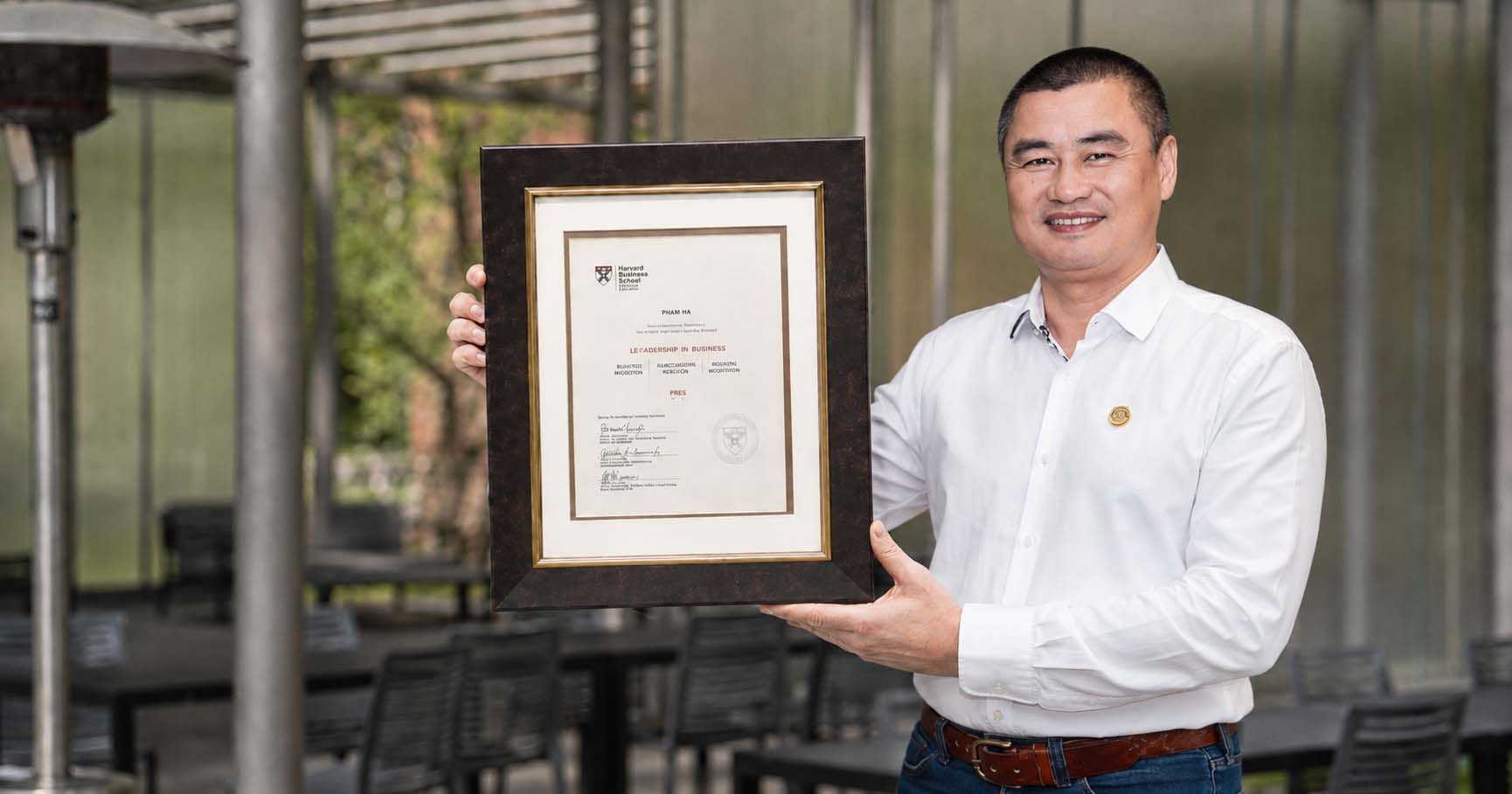
Completing three Harvard Business School Online courses reinforced a simple lesson: an inspiring vision creates direction, but disciplined capital allocation turns that vision into enduring value.
By Dr. Phạm Hà – Founding President and CEO, LuxGroup®
For more than two decades, I have built businesses around a deeply personal conviction: Vietnam can create world-class luxury experiences rooted in its own culture, history, art, landscapes, and human warmth.
That conviction helped transform a specialist luxury tour operator founded in 2005 into LuxGroup®, a diversified ecosystem encompassing destination management, cruises, yachts, hotels, restaurants, transportation, art, heritage, and cultural experiences. We describe LuxGroup as a “house of small narrative giants” because each brand has its own story, identity, and entrepreneurial energy while contributing to a shared purpose.
But imagination alone cannot sustain a group of businesses. As an organization expands, leadership must evolve from launching ideas to allocating capital, managing risk, measuring performance, and protecting long-term value.
My completion of three Harvard Business School Online courses—Leading with Finance, Strategic Financial Analysis, and Sustainable Investing—and the resulting Certificate of Specialization in Finance and Accounting gave me a more integrated framework for this responsibility.
The greatest value was not learning finance as a collection of formulas. It was learning to connect financial reasoning with strategy, sustainability, and execution.
Finance Is a Leadership Language
Leading with Finance reinforced that finance should not be confined to accountants, investment professionals, or the chief financial officer. It is a leadership language.
Every important strategic decision has financial consequences. Opening a new destination, building a cruise vessel, acquiring an asset, launching a hotel, developing a restaurant, or investing in technology requires capital today in anticipation of future benefits. Leaders must determine whether those expected benefits justify the resources and risks involved.
This requires understanding cash flow, the time value of money, the cost of capital, return on invested capital, and the relationship between risk and expected return. Revenue growth alone does not prove that an investment creates value. A project can increase sales while destroying capital if its return remains below the organization’s financing cost or if cash arrives too late to support its obligations.
This lesson is especially relevant to LuxGroup. Tourism contains businesses with very different capital profiles. A destination management company can expand relatively quickly with talent, technology, and distribution. A cruise business requires substantial investment in design, construction, safety, technical systems, crewing, sales, and maintenance before the first guest steps aboard.
The financial logic for each business must therefore be different.
At LuxGroup, this means strengthening P&L accountability across business units, examining cash conversion rather than revenue in isolation, and requiring major projects to demonstrate how they will create value. Financial discipline does not weaken entrepreneurial ambition. It protects the organization’s ability to keep pursuing it.
Strategic Analysis Begins Behind the Numbers
If Leading with Finance taught me to ask whether an investment creates value, Strategic Financial Analysis deepened my ability to investigate why a company performs as it does and whether that performance can continue.
Financial statements are not simply historical records. Properly interpreted, they reveal a company’s operating model, strategic choices, competitive position, and vulnerabilities.
Profit margins can indicate pricing power or operational efficiency. Asset turnover shows how effectively resources generate revenue. Leverage can increase shareholder returns but also amplify risk. Return on equity may appear impressive until it is separated into its underlying drivers. Return on invested capital provides a clearer test of whether management is turning resources into economic value.
This analytical discipline matters in a diversified organization. A profitable business is not automatically an attractive growth platform. Leaders must distinguish between accounting profit, cash generation, strategic contribution, and capital efficiency.
Strategic analysis also requires looking forward. Discounted cash flow models, valuation multiples, scenario analysis, and bull-and-bear cases help translate assumptions about growth, margins, capital expenditure, and risk into a range of possible values.
The objective is not to predict the future perfectly. As John Maynard Keynes is often quoted, “It is better to be roughly right than precisely wrong.” The purpose of valuation is to make assumptions visible so they can be challenged.
For LuxGroup, this approach can improve decisions about fleet expansion, new destinations, hotel development, brand partnerships, and potential acquisitions. Before approving a project, we should ask:
- What customer need does it solve?
- What competitive advantage makes its returns sustainable?
- How much capital will it require before generating positive cash flow?
- What assumptions drive the valuation?
- What happens if demand, price, cost, or timing differs from the plan?
- Is building internally better than partnering with or acquiring another business?
These questions replace enthusiasm-driven expansion with evidence-based growth.
Sustainable Investing Expands the Definition of Value
The third course, Sustainable Investing, broadened the discussion beyond conventional financial returns. It demonstrated that environmental, social, and governance factors are not separate from business performance. They can materially affect demand, operating costs, asset values, regulation, access to capital, employee engagement, reputation, and long-term resilience.
Sustainable investing exists along a continuum. Some investors primarily seek market-rate returns while integrating ESG risks. Others intentionally invest in measurable social or environmental outcomes. Some accept concessionary returns to reach beneficiaries or markets that commercial capital cannot yet serve.
The crucial requirement is clarity of intention.
A company should not claim impact merely because it operates in a desirable sector or publishes an ESG statement. Credible impact requires defined objectives, relevant metrics, transparent assumptions, and evidence that activities lead to meaningful outcomes.
The course’s impact logic chain provides a practical framework:
Inputs → Activities → Outputs → Outcomes → Impact
For a tourism company, training local employees is an activity. The number of people trained is an output. Higher incomes, career progression, or stronger financial security are outcomes. More inclusive and resilient communities represent the broader impact.
This distinction is essential because companies frequently report what they did rather than what changed.
Applying ESG to the LuxGroup Case
Sustainability is particularly material to LuxGroup because our businesses depend on healthy destinations, cultural authenticity, community trust, skilled employees, and stable natural ecosystems.
A polluted bay, degraded heritage site, extreme weather event, or community excluded from tourism’s benefits is not only a social or environmental concern. It is also a strategic and financial risk.
LuxGroup’s ESG journey already includes Travelife certification, our 5G principles—Global, Green, Digital, Pride, and Happiness—and our ambition to become a net-positive business by 2030. The course encouraged me to convert these commitments into a more measurable management system.
For example, our environmental indicators can include energy and fuel consumption, greenhouse gas emissions, water use, waste generation, plastic reduction, and responsible procurement. Social indicators can cover local employment, training hours, career advancement, employee welfare, gender inclusion, community sourcing, and cultural preservation. Governance measures can include safety, compliance, data quality, board oversight, accountability, and transparent reporting.
The goal is not to collect the largest possible number of metrics. It is to identify the measures that inform decisions and reveal whether we are genuinely improving.
Impact measurement should be “rigorous but not rigid.” Some outcomes require robust external evaluation, while others can be monitored through operational data, customer feedback, employee surveys, and community engagement. The level of rigor should match the importance of the claim and the resources involved.
One Integrated Investment Framework
Together, the three courses suggest that every major LuxGroup investment should pass through three lenses.
First, the financial lens: Does the project generate an appropriate return relative to its capital requirements and risk?
Second, the strategic lens: Does it strengthen a distinctive capability, brand, market position, or customer relationship that competitors cannot easily replicate?
Third, the impact lens: Does it create measurable value for employees, communities, culture, and the environment while avoiding material harm?
A project that passes only one lens is incomplete.
A financially attractive project that damages a destination may destroy long-term value. A high-impact project without a viable economic model may remain dependent on continuous support. A strategically exciting idea without disciplined execution can consume capital without producing either return or impact.
The strongest opportunities lie near what sustainable investing describes as the efficient impact frontier: investments that achieve the greatest possible impact for a given level of financial return, or the strongest financial performance for a chosen impact objective.
The Next Stage of Leadership
Earning the Certificate of Specialization in Finance and Accounting is not the conclusion of a learning journey. It marks a transition in how I intend to lead LuxGroup into its next chapter.
Our ambition remains bold: to build distinctive Vietnamese brands, develop a national waterways vision, create meaningful luxury experiences, preserve cultural memory, and demonstrate that business can deliver both happiness and lasting value.
But ambition must now be supported by clearer investment gates, stronger business-unit accountability, scenario-based planning, disciplined valuation, and measurable ESG outcomes.
The central lesson from these three courses is simple: finance determines whether we can continue creating impact; strategy determines where we should compete; and sustainability determines whether the value we create can endure.
At LuxGroup, we do not want to become the biggest organization. We want to become the best at transforming Vietnamese culture, heritage, and hospitality into experiences that create value for guests, employees, communities, investors, and future generations.
Vision gives us the destination.
Disciplined finance, strategic analysis, and sustainable investment give us the means to reach it.
Author’s note: This article reflects Dr. Phạm Hà’s independent learning and application of concepts studied through Harvard Business School Online. It is not an official Harvard Business School case study or a Harvard Business Review publication.