



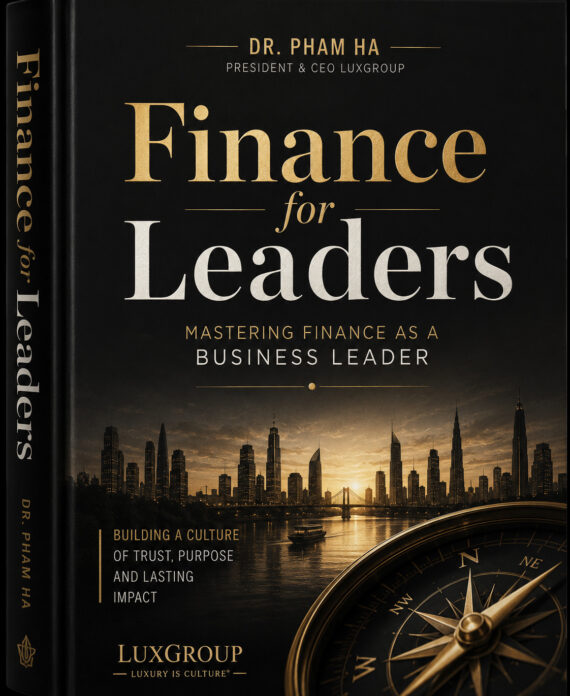
By Dr. Pham Ha – Founder, Chairman & CEO of LuxGroup
Throughout my entrepreneurial journey, I have often heard business leaders say, “I’m not good at finance—that’s what my CFO is for.” It sounds reasonable, but it is also one of the most dangerous misconceptions in modern leadership. A CEO does not need to become an accountant, but every CEO must become financially literate. Leadership is not merely about managing people or operations; it is about making decisions that determine how scarce resources are transformed into lasting value.
The difference between accounting and finance is not the numbers themselves but their purpose. Accounting records what has already happened and ensures accuracy and compliance. Finance looks ahead, helping leaders evaluate opportunities, anticipate risks, allocate capital, and shape strategy. Accounting explains the past; finance designs the future. For this reason, finance should never be viewed as a support function. It is a strategic discipline at the heart of leadership.
The most important responsibility of a CEO is not signing contracts, attending meetings, or even inspiring people. It is capital allocation. Every decision to hire talent, expand into a new market, launch a product, invest in artificial intelligence, acquire a company, or build a new facility is ultimately a decision about where to deploy capital. Whether leaders recognize it or not, every CEO serves as the organization’s Chief Capital Allocator, entrusted with converting limited resources into sustainable competitive advantage.
To make sound decisions, leaders must first learn to read a business through its three essential financial statements. The balance sheet reveals what a company owns, owes, and finances through shareholders’ equity. The income statement explains how value is created through revenue, costs, and profits. The cash flow statement tells the most important story of all—how cash actually moves through the business. Together, these reports provide a complete picture of financial health and strategic resilience.
One of the greatest misconceptions in business is equating profit with success. Profit is essential, but profit is not cash. A company can report impressive earnings while running out of money to pay employees, suppliers, or lenders. The COVID-19 pandemic reminded the world that businesses rarely fail because they lack customers alone; they often fail because they lack liquidity. Revenue creates excitement, profit creates confidence, but cash creates survival. This is why the timeless principle, Cash is King, remains one of the most important lessons every leader must embrace.
At a higher level, the objective of business is not simply to maximize revenue or even profit. The ultimate objective is to maximize enterprise value. A company may grow rapidly while destroying shareholder wealth if growth requires excessive capital and produces inadequate returns. Conversely, a business that grows steadily while generating strong cash flow and high returns on invested capital often creates far greater long-term value. Exceptional CEOs therefore focus less on revenue growth alone and more on metrics such as ROIC, WACC, free cash flow, and enterprise value creation.
Investment decisions should never be driven by intuition alone. Every project competes for limited capital and must justify its existence through disciplined financial analysis. Concepts such as Net Present Value (NPV), Internal Rate of Return (IRR), Discounted Cash Flow (DCF), and the Time Value of Money are not technical exercises reserved for financial analysts; they are decision-making frameworks for leaders. Great companies are built by consistently investing in opportunities that create value over decades, not merely by chasing short-term profits.
Yet finance is more than spreadsheets and formulas. It is also the discipline of managing uncertainty. Markets are influenced not only by fundamentals but also by fear, greed, overconfidence, and herd behavior. History repeatedly shows that financial crises are often driven by human psychology rather than mathematics. Outstanding leaders therefore combine analytical thinking with humility, preparing for multiple scenarios, protecting liquidity, and building organizations capable of withstanding unexpected shocks.
Artificial intelligence is transforming the financial landscape at an unprecedented pace. AI can forecast demand, automate budgeting, identify anomalies, and improve financial reporting with remarkable speed and precision. However, technology cannot replace judgment, ethics, or vision. AI can generate options, but it cannot define purpose. It can calculate financial outcomes, but it cannot determine what kind of company we aspire to build. The future belongs to leaders who combine technological capability with sound financial judgment and responsible decision-making.
After more than two decades of building LuxGroup, I have learned that sustainable success is not measured by how much money a company earns, but by how wisely it allocates capital. Every investment we have made—from luxury travel experiences to boutique cruises and the development of Amiral Cruises—has been guided by one fundamental question: Will this decision create greater long-term value for our customers, employees, shareholders, and society? That philosophy continues to shape our vision for Vietnam Waterways 2045, where Vietnamese innovation, culture, and hospitality become engines of national value creation.

I firmly believe that great companies are not built solely on brilliant ideas or advanced technology. They are built through disciplined financial decisions made consistently over many years. A CEO does not need to memorize every financial formula, but must understand how financial information reflects strategy, operational excellence, competitive advantage, and future potential. When leaders become fluent in the language of finance, they gain the ability not only to manage businesses more effectively, but also to create enduring value for generations to come.
Ultimately, finance is not the science of numbers. It is the art of allocating capital, making better decisions, and building organizations that create lasting value. That is why finance is the universal language of leadership in the twenty-first century.