

A six-day expedition through underground rivers, primeval jungle and a 90-metre wall revealed that Son Doong’s greatest luxury is not exclusivity, but perspective.
Dr. Pham Ha, Founding President & CEO LuxGroup
“In Son Doong, nature does not become smaller because we pass through it. We become more aware of our own scale.”
A place opened by chance
The call came in early August 2026. A traveller had withdrawn from a Son Doong expedition for health reasons, leaving one place on a departure scheduled for August 3 to 8. For years I had tried, unsuccessfully, to secure a spot on the tightly controlled journey. Now I had only a short window in which to decide.
I said yes almost immediately. What followed was less spontaneous: a medical questionnaire, a fitness review and a sober assessment of whether I was ready for Oxalis Adventure’s highest-level expedition. Regular walking and cycling, together with previous treks across Fansipan, Cat Ba, Bach Ma and Nam Cat Tien, gave me a foundation. Still, no training fully prepares you for a landscape that rearranges your sense of proportion.
The six-day programme covers roughly 25 kilometres through jungle and cave terrain, includes repeated river crossings, three nights underground and a cumulative elevation challenge that asks as much of concentration as it does of the legs. Each group is limited to 10 guests and supported by a much larger team of guides, safety specialists, chefs, porters and forest rangers. The rarity of the experience may suggest luxury. The reality is more elemental: wet boots, mud, darkness, cold water and complete dependence on one another.
Leaving the connected world behind
We set out from kilometre 35 on the western branch of the Ho Chi Minh Highway, moving beneath the dense canopy of the Truong Son range. Phone signals faded. Emails, meetings and the reflex to be constantly reachable disappeared with them. The soundscape narrowed to water, insects and the rhythm of boots on a damp forest trail.
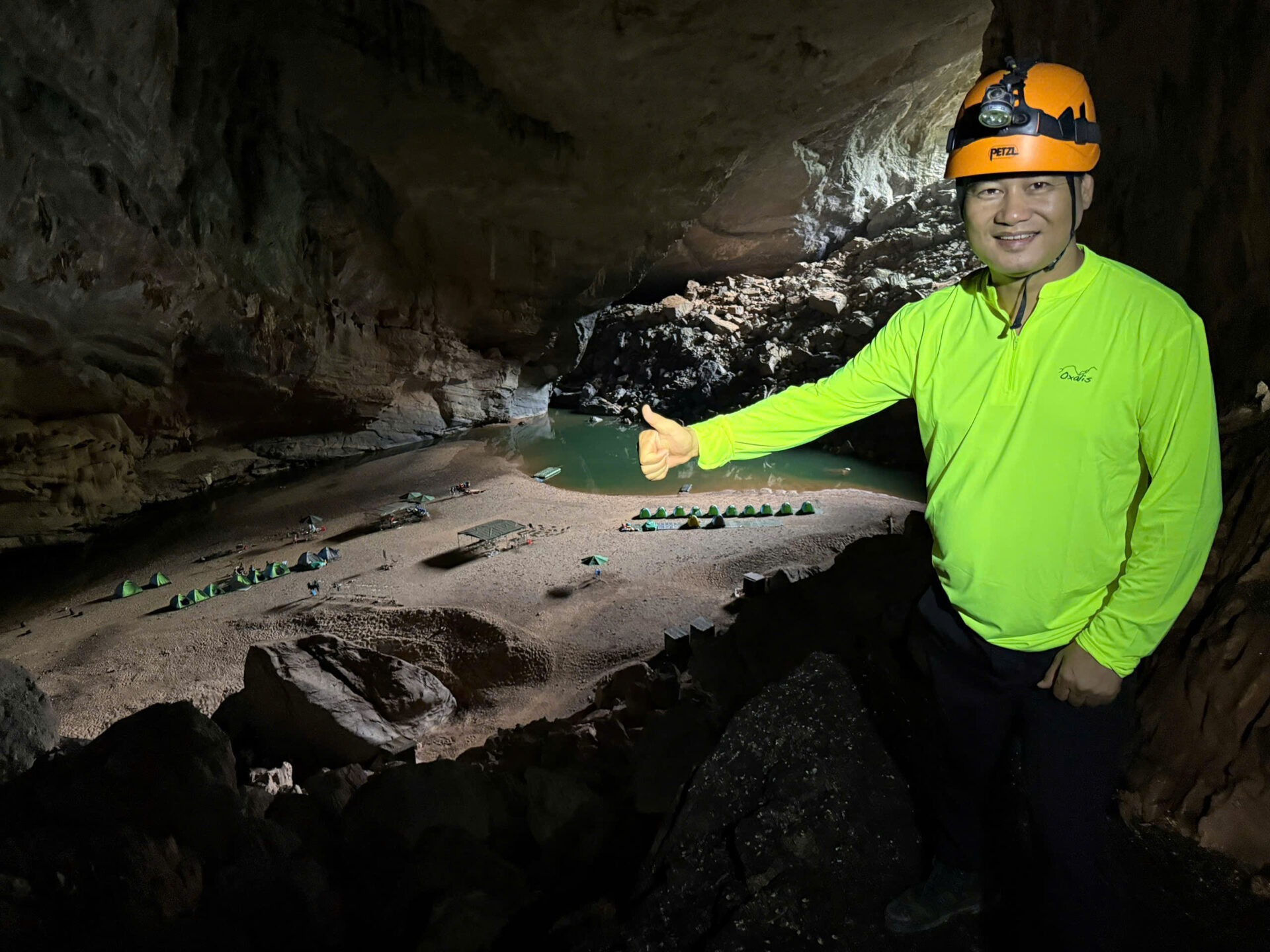
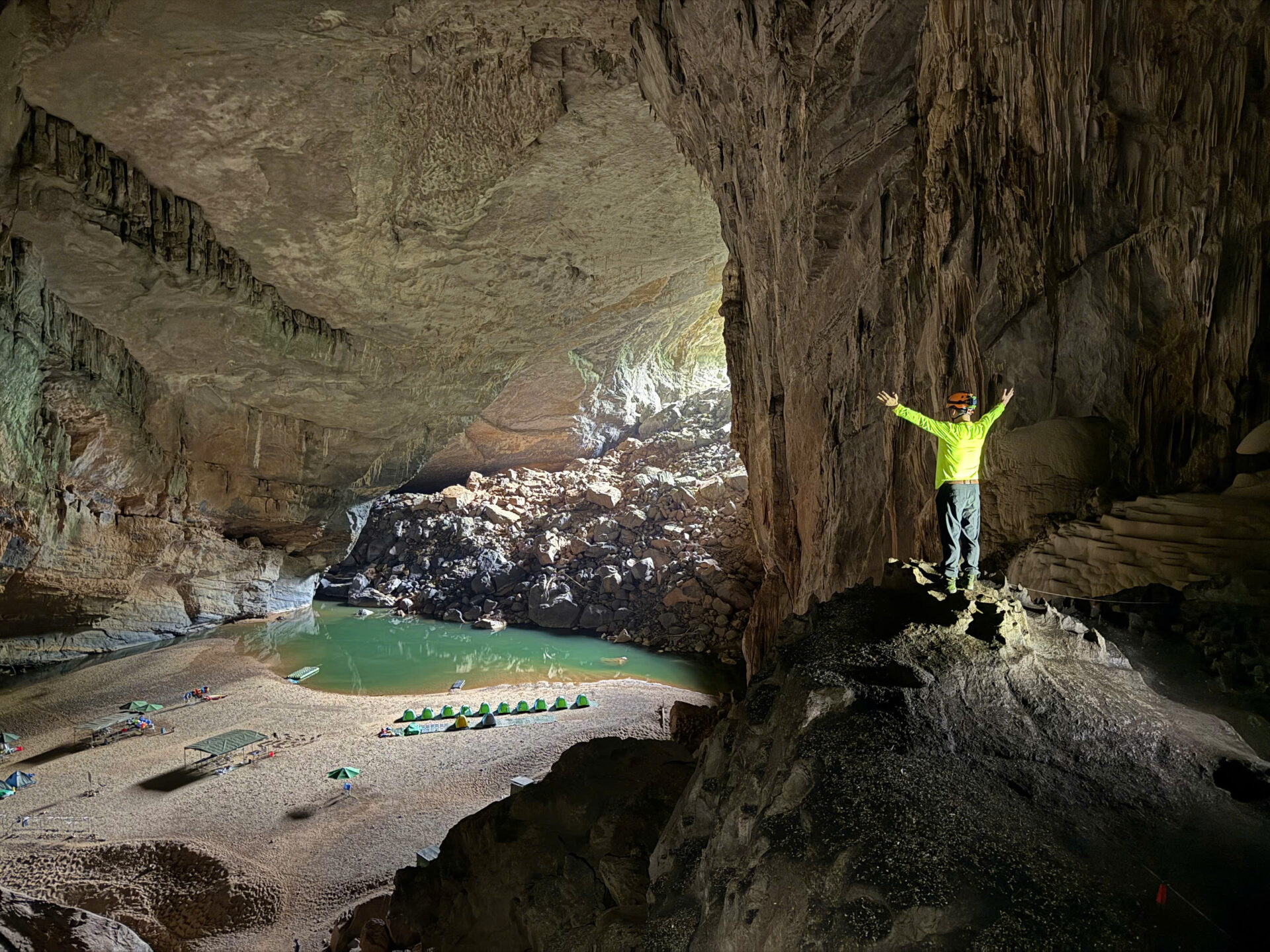
Our route passed Ban Doong, a small Bru-Van Kieu community surrounded by forest, before dropping towards Hang En. Entering the cave required scrambling over boulders and descending gradually into a chamber of improbable scale. Beneath the arch of rock, an emerald pool met a crescent of sand where our tents waited.
After the day’s heat and effort, swimming in that cool water changed my definition of indulgence. There was no spa, no infinity pool and no perfectly choreographed service ritual—only water, wind, sand and a tired body receiving exactly what it needed. That evening, with hot coffee in hand, I listened to an underground stream, rain beyond the cave mouth and swifts calling from the roof. Silence was no longer an absence. It was the rarest amenity of all.
The cave sets the pace
The next morning we crossed Hang En and followed the Rao Thuong valley towards the entrance of Son Doong. A river raced through the green valley and then vanished into limestone—a local phenomenon known as a sinking stream. Beyond it, cold air and mist breathed from the earth.
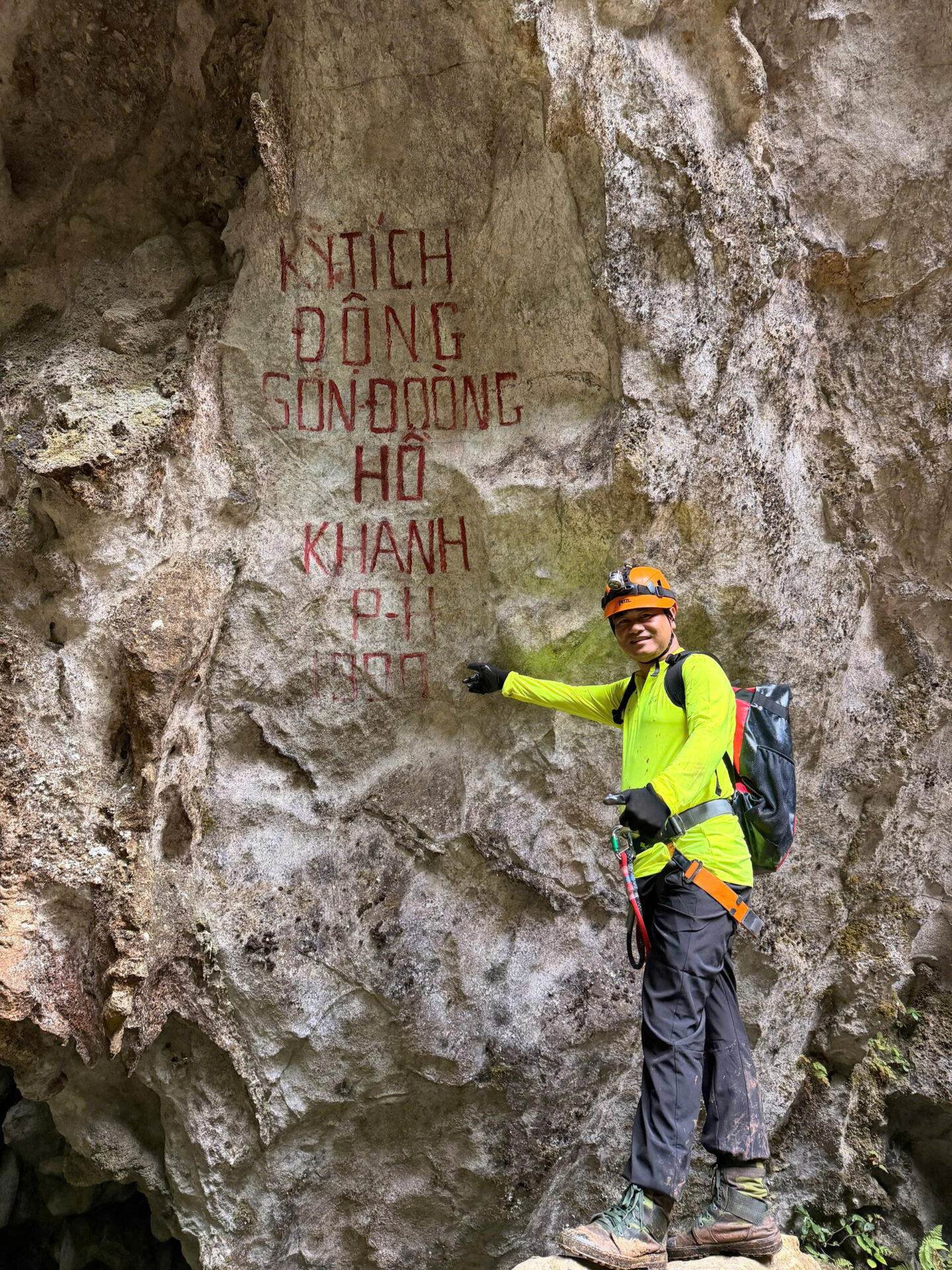
Before our descent, our guide Lê Thành Đạt offered a reminder that would shape the rest of the expedition: “Son Doong is not a place to rush. The cave sets the pace. We read the water, the rock and every person’s movement; safety begins with respecting all three.”
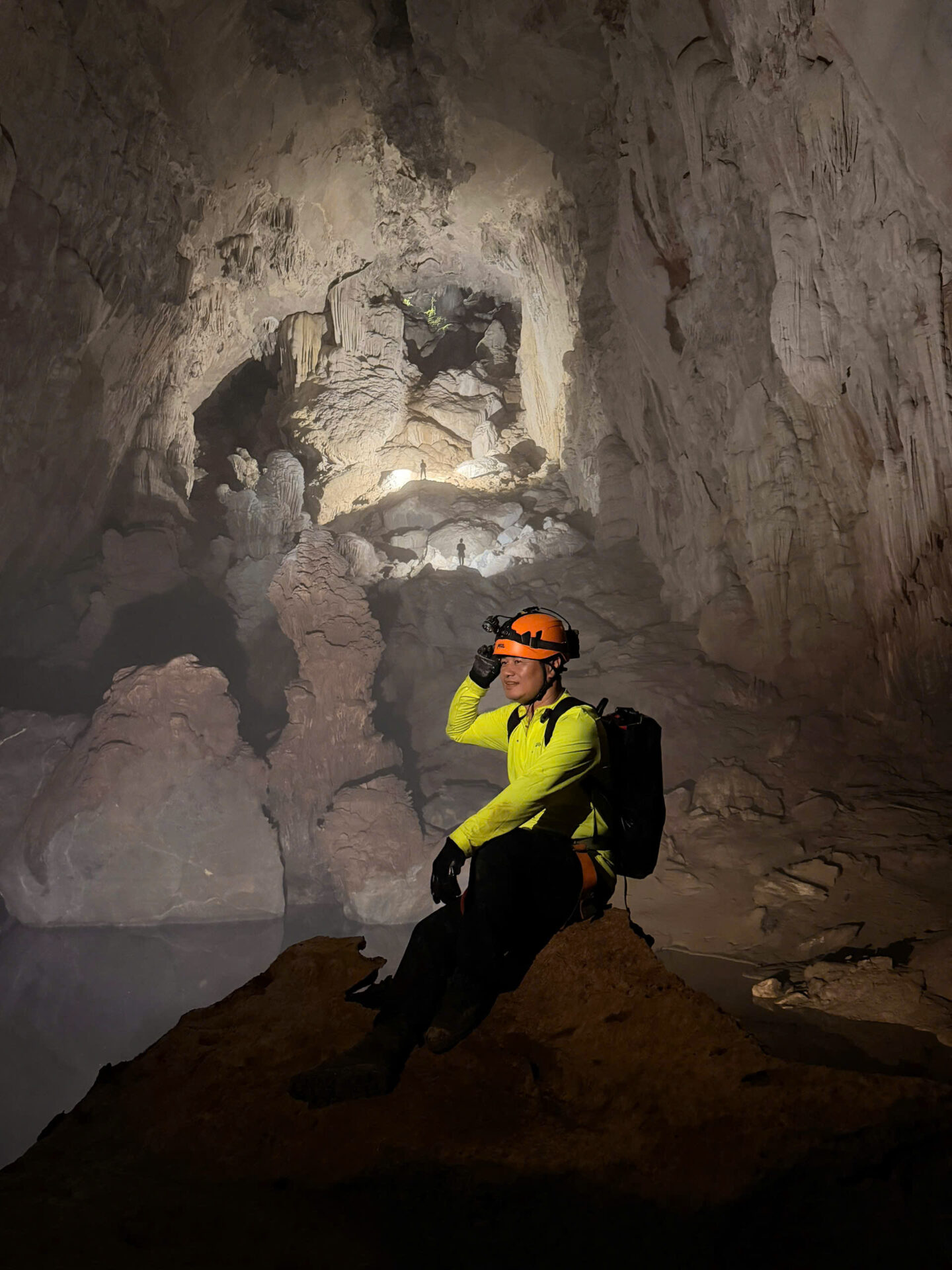
Harnesses were checked, carabiners clipped and headlamps switched on. As daylight receded, we descended a steep section of about 90 metres with ropes and safety equipment. In the vastness, the people ahead shrank into a constellation of moving lights. Outside the cave, ambition often encourages us to appear larger. Inside Son Doong, the landscape returns everyone to their true dimensions.
The cave is nearly nine kilometres long and has a measured volume of 38.5 million cubic metres. Its largest passages rise beyond 200 metres and stretch more than 150 metres across. Aircraft comparisons are often used to make those figures intelligible, but numbers remain abstract until you stand beneath a ceiling that produces its own clouds. Stone, water, mist and light combine to create scenes less like geology than another planet.
Where daylight enters the underworld
We crossed an underground river, climbed sand banks and passed the Hand of Dog, a colossal stalagmite silhouetted against distant light. Near Doline 1, known as Watch Out for Dinosaurs, sunbeams fell through a collapsed section of ceiling and caught the mist. The Wedding Cake formation emerged below it, theatrical yet entirely untouched by human design.
From Doline 1, the route continued over complex limestone towards Doline 2 and the Garden of Edam. After hours in darkness, a primeval forest appeared beneath an opening more than 200 metres above. Tall, narrow trees reached for light; ferns and moss softened the rock; birds crossed a pocket of sky. This was not greenery arranged inside a cave. It was a self-contained world, with its own weather, light and tempo.
The organisms that thrive here offer a quiet lesson in resilience. Life does not endure by rigidly resisting every condition. It adapts without surrendering its essential nature. For someone who leads a business, the parallel was difficult to miss: transformation is not the abandonment of identity, but the discovery of how that identity can remain alive under new circumstances.
The invisible architecture of safety
Ten guests may be the visible expedition, but nearly 30 people make the journey possible. Porters move ahead with food and camp equipment. Chefs create warm meals in places without roads or electricity. Safety experts identify risks long before a guest recognises them. A hand appears beside a slippery foothold; a calm instruction arrives before uncertainty turns into fear.
The experience reminded me that the most sophisticated service is often invisible. Professionalism is not simply what a guest sees; it is the hundreds of potential problems quietly prevented. In an environment where carelessness has consequences, trust becomes tangible. It is built one checked buckle, one steady voice and one shared step at a time.
Ninety metres, one step at a time
On the final day inside Son Doong, we reached the Great Wall of Vietnam, a 90-metre calcite barrier—the height of roughly a 30-storey building. From its base, the top was almost impossible to see. Fatigue gave the wall a second dimension: it rose not only in front of me, but inside my mind.
A job title offered no advantage there. No business achievement could lift me by a metre; no reputation could place my next foot. The climb begins on a fixed steel ladder and continues up steep rock with ropes, a full-body harness and the close supervision of the safety team. Rather than contemplate the entire wall, I reduced the challenge to its smallest unit: one foothold, one breath, one more step.
No single step felt heroic. Repeated while the body was tired and the mind uncertain, however, those modest acts eventually brought daylight into view. At the top I felt no triumph over nature. I felt gratitude—to a body that had continued, to the team that had protected us, and to the companions whose presence made courage feel shared rather than solitary.
The luxury of perspective
Son Doong existed for millions of years before us and will continue long after we are gone. Passing through it does not diminish the cave. Instead, its scale reduces our anxieties, status and self-importance to their proper proportions.
I entered with the mindset of overcoming a formidable challenge. I emerged understanding that nature did not need to be conquered. If anything, it had conquered something in me: the pride that imagines control is the same as strength. Six days after the last-minute call, I left the forest with tired legs, scratched skin and a different relationship with my own limits.
Son Doong had not changed. I had. And perhaps that is the real privilege of travelling far beyond comfort—not collecting another place, but returning with a more honest version of yourself.
Plan Your Son Doong Expedition
- Where: Phong Nha-Ke Bang National Park, central Vietnam.
- Operator: Oxalis Adventure is the authorised operator for the expedition.
- Duration: Six days and five nights, including three nights camping underground.
- Group size: A maximum of 10 guests, accompanied by a professional support team.
- Physical demands: Around 25 kilometres of jungle and cave travel, frequent river crossings, rocky scrambling, rope work and the 90-metre Great Wall of Vietnam ascent.
- Best preparation: Consistent cardiovascular training, stair climbing and recent multi-day trekking experience on steep, uneven terrain.