

By LuxGroup.vn Editorial
For decades, business literature has revolved around a familiar vocabulary: growth, competitive advantage, shareholder value, innovation, and operational excellence. From Peter Drucker’s management philosophy to Michael Porter’s competitive strategy, from Jim Collins’ enduring companies to Simon Sinek’s purpose-driven leadership, each generation has attempted to answer one enduring question: How do organizations achieve lasting success? Dr. Pham Ha’s new book, Sustainable Luxury: A Purpose-Driven Business Strategy, dares to ask a far more consequential question—what if success itself needs to be redefined? Rather than pursuing a better version of twentieth-century capitalism, the book proposes a management philosophy for the twenty-first century, one in which businesses are measured not only by what they earn, but also by what they preserve, regenerate, and ultimately leave behind.
Instead of offering another handbook on ESG reporting, sustainability compliance, or luxury marketing, the book presents a coherent management philosophy built upon six interconnected forms of capital: financial, human, cultural, natural, social, and legacy capital. The central proposition is both ambitious and refreshingly practical. Organizations create enduring competitive advantage not by optimizing one form of capital—financial wealth—but by growing all six simultaneously. Sustainability therefore becomes more than environmental responsibility, while luxury becomes more than exclusivity. Together, they evolve into a comprehensive operating system where profitability, people, heritage, communities, ecosystems, and long-term stewardship reinforce one another rather than compete for management attention.
One of the book’s greatest achievements is rhetorical rather than technical. Throughout business history, influential thinkers have rarely succeeded simply because they introduced new theories. They succeeded because they gave leaders memorable language through which to understand complex realities. Drucker offered “management by objectives.” Porter gave us “competitive advantage.” Collins introduced the “Flywheel.” Sinek reminded us to “Start With Why.” Dr. Pham Ha contributes a vocabulary equally distinctive: Luxury is Culture®, Purpose Before Profit™, People First®, Heartware over Hardware™, Present • Personal • Unrushed™, and Legacy Capital™. These phrases function as conceptual anchors rather than marketing slogans, translating sophisticated strategic thinking into memorable ideas capable of shaping executive conversations, organizational culture, and long-term leadership practice.
Equally compelling is the book’s treatment of shareholder capitalism. Rather than dismissing financial performance or portraying capitalism as fundamentally flawed, Dr. Ha proposes a more nuanced evolution. Profit remains indispensable because no organization can create value without financial discipline. Yet profit is repositioned as the consequence of creating broader forms of value rather than the sole purpose of business itself. This subtle distinction reflects the emerging global movement toward stakeholder capitalism while avoiding ideological polarization. Instead of replacing markets, the book seeks to enrich them, arguing that organizations capable of serving employees, communities, culture, and nature ultimately generate stronger financial performance over the long term than those pursuing quarterly returns alone.
Perhaps the book’s most original intellectual contribution is its redefinition of luxury. For generations, luxury has been associated with scarcity, wealth, exclusivity, prestige, and conspicuous consumption. Dr. Ha deliberately dismantles that narrative and reconstructs it around an entirely different foundation. Luxury becomes preservation rather than possession. Craftsmanship rather than excess. Authenticity rather than status. Cultural memory rather than material accumulation. Stewardship rather than consumption. This rhetorical transformation reflects profound shifts occurring within global luxury markets, where increasingly sophisticated travelers and consumers seek experiences rooted in meaning, local identity, craftsmanship, and emotional authenticity instead of visible displays of wealth. Luxury is no longer defined by what separates people from others, but by what connects them more deeply to people, places, and history.
Unlike many books written by entrepreneurs that primarily celebrate corporate achievements, Sustainable Luxury wisely positions LuxGroup not as the hero of the narrative but as what the author repeatedly describes as a living laboratory. Over more than twenty years, the organization experimented with boutique hospitality, cultural preservation, regenerative tourism, employee happiness, community partnerships, and slow, purposeful growth before formalizing these observations into Sustainable Luxury Strategy™. Consequently, readers encounter ideas that emerged from continuous experimentation rather than theories searching for practical validation. This inversion significantly enhances the book’s credibility because experience consistently precedes abstraction, allowing frameworks to feel lived rather than invented.
Among the book’s most significant conceptual contributions is undoubtedly the Six Capitals Framework. Financial, Human, Cultural, Natural, Social, and Legacy Capital are presented not as separate performance indicators but as an integrated ecosystem where strength in one reinforces strength across all others. Unlike many ESG frameworks that compartmentalize environmental, social, and governance issues alongside financial reporting, Dr. Ha proposes that long-term competitive advantage emerges precisely because these capitals develop together. Financial resilience supports cultural investment. Strong cultures elevate human potential. Healthy communities reinforce trust. Regenerated ecosystems strengthen long-term prosperity. The elegance of the model lies in its remarkable simplicity—six memorable concepts capable of organizing an entire philosophy of business without unnecessary complexity or academic jargon.
Complementing the Six Capitals is what may become the book’s signature visual model: the Sustainable Luxury Flywheel™. Here, purpose generates culture; culture shapes people; people create memorable experiences; experiences build trust; trust inspires loyalty; loyalty produces sustainable profit; profit funds regeneration; regeneration renews purpose. Unlike linear strategic planning models, the Flywheel illustrates business as a living, self-reinforcing system where each element compounds the effectiveness of the next. It extends Jim Collins’ original Flywheel concept by integrating emotional intelligence, cultural stewardship, environmental regeneration, and financial performance into one continuous cycle. Rather than relying on constant expansion or increasingly expensive customer acquisition, organizations generate momentum through authentic relationships, creating resilience that strengthens with every successful revolution of the wheel.
One of the book’s most refreshing qualities is its unmistakably Vietnamese intellectual perspective. While readers will recognize influences from Drucker, Porter, Collins, Sinek, stakeholder theory, positive psychology, and Eastern philosophy, Sustainable Luxury never feels derivative. Vietnamese waterways, artisanal traditions, hospitality, heritage preservation, community values, and cultural identity are not decorative examples added to Western frameworks; they become the foundation upon which an entirely original philosophy is constructed. Rather than arguing that Vietnam should simply import international management thinking, Dr. Ha quietly proposes the opposite—that Vietnam possesses cultural wisdom capable of enriching global conversations about leadership, sustainability, and luxury. That intellectual confidence gives the book a distinctive voice rarely encountered in contemporary business publishing.
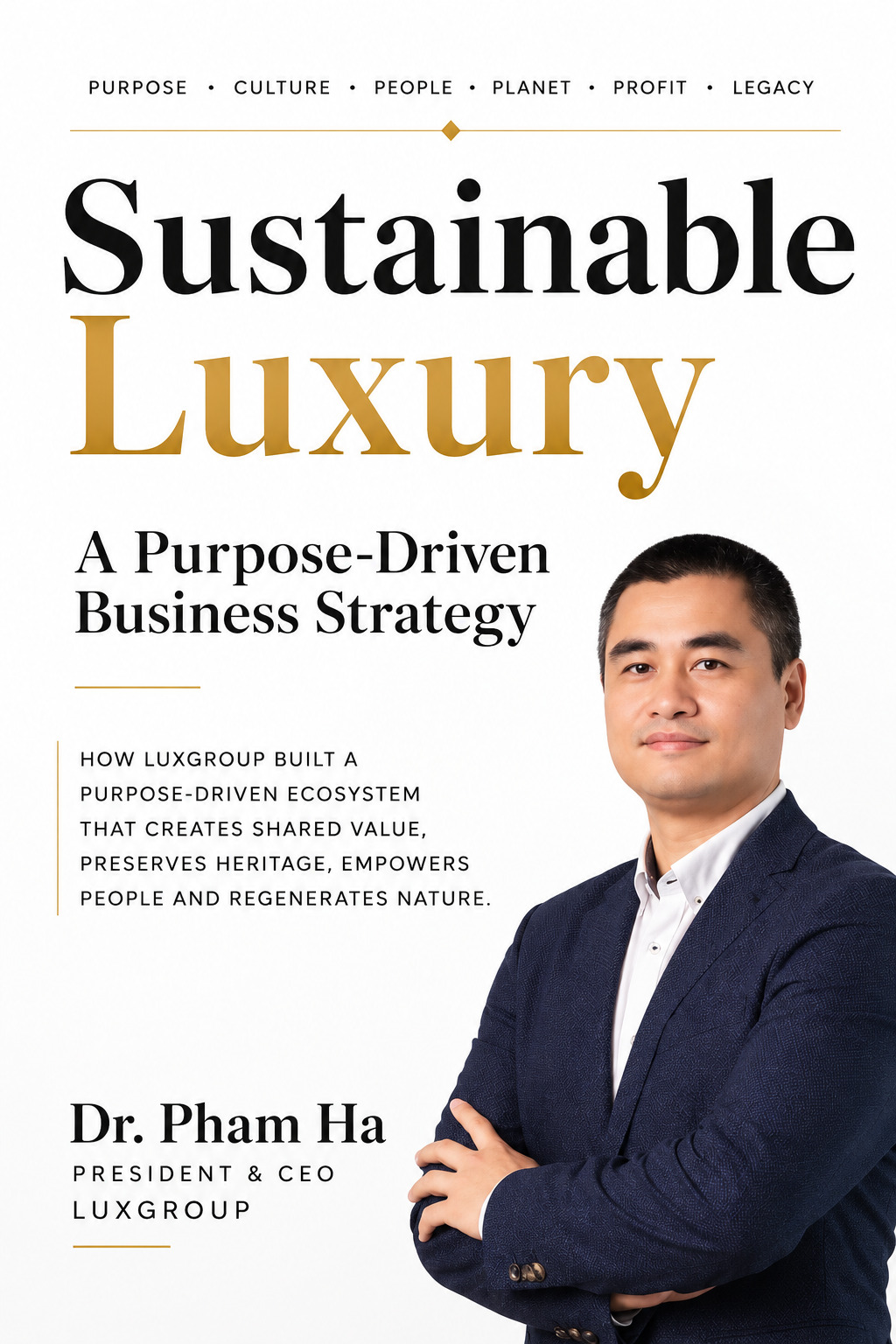
Its ambition, however, also reveals opportunities for refinement. Because the book seeks to establish an entirely new management philosophy, several foundational concepts—purpose, regeneration, stakeholder value, and the Six Capitals—reappear throughout multiple chapters using similar rhetorical structures. Greater editorial compression would strengthen narrative rhythm without sacrificing conceptual richness. Likewise, although LuxGroup serves effectively as the book’s primary laboratory, incorporating additional international examples—perhaps Patagonia, Hermès, Aman, Interface, Natura, or Brunello Cucinelli—would further demonstrate the universal applicability of the proposed frameworks. Executive summaries, visual diagrams, implementation scorecards, and practical diagnostic tools would also enhance accessibility for senior leaders seeking immediate application within their own organizations.
Ultimately, Sustainable Luxury: A Purpose-Driven Business Strategy deserves recognition not because it offers another variation of sustainability or luxury management, but because it attempts something considerably more ambitious. It seeks to redefine the architecture of business itself. By integrating financial discipline with human flourishing, cultural stewardship, environmental regeneration, social trust, and enduring legacy, Dr. Pham Ha contributes an original management philosophy emerging from Vietnam while speaking directly to global leadership challenges. Whether Sustainable Luxury eventually joins the ranks of influential management frameworks will depend not on the author alone but on whether executives, entrepreneurs, policymakers, educators, and investors choose to test, refine, and apply its ideas. Yet its central question already resonates with unusual clarity: Can organizations become more profitable precisely because they leave people happier, culture richer, communities stronger, and nature healthier than they found them? If the next era of business is defined by that question rather than simply by quarterly earnings, then Sustainable Luxury may prove to be not merely a timely publication, but the beginning of a new management conversation.