

In an era where artificial intelligence is reshaping productivity and automation is redefining efficiency, one question is quietly emerging at the heart of modern business: what remains uniquely human at work?
For LuxGroup, the answer is not technology, scale, or even capital.
It is emotion—designed, nurtured, and sustained.
And increasingly, it is also sustainability—not as compliance, but as culture.
Audited, Recognized, and Lived
In 2025, LuxGroup® was independently assessed and recognized among Asia’s best sustainable workplaces, following a rigorous audit aligned with regional benchmarks such as HR Asia’s Best Companies to Work for in Asia and sustainable workplace evaluation frameworks.
But the distinction is not the story.
The story is why it qualified.
Across measured dimensions—culture, leadership, employee engagement, and sustainability integration—the company scored above market averages, with sustainability emerging not as a policy layer, but as the highest-performing cultural dimension.
In most organizations, sustainability sits in reports.
At LuxGroup®, it lives in behavior.
From ESG Strategy to Everyday Experience
While many companies adopt ESG (Environmental, Social, Governance) frameworks to meet investor expectations, LuxGroup® has internalized sustainability as a daily lived experience.
This manifests in tangible ways:
* A commitment to zero plastic operations across its travel ecosystem.
* A roadmap toward net positive impact by 2030, particularly in destinations where tourism intersects with fragile ecosystems.
* A Travelife-certified operating model within its flagship tour operator, reinforcing global sustainability standards.
But beyond systems and certifications lies a more subtle transformation.
Employees are not instructed to “follow ESG policies.”
They are encouraged to feel responsible for the environments and communities they engage with.
That shift—from compliance to consciousness—is what distinguishes a sustainable workplace from a merely compliant one.
Designing Culture as Infrastructure
Sustainability at LuxGroup® is not confined to environmental initiatives. It extends into how the workplace itself is designed.
The company’s offices are intentionally curated to foster aesthetic awareness and emotional balance—an approach rarely associated with ESG, yet deeply connected to employee wellbeing.
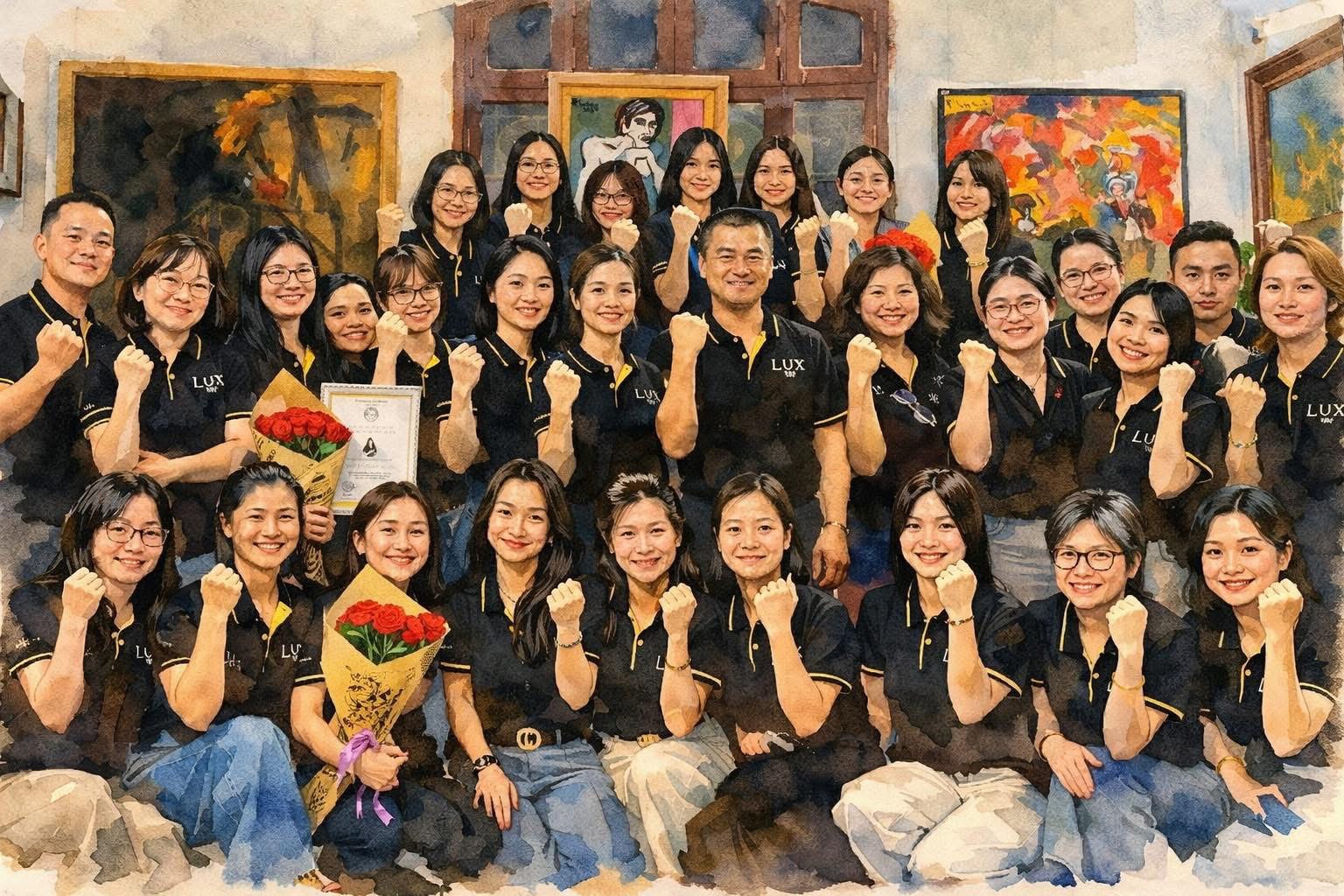
Art plays a central role. Works inspired by artists such as Phạm Lực are integrated into daily spaces, creating moments of reflection within the rhythm of work.
Internal initiatives like “Trà Tranh”—informal gatherings around art and conversation—offer employees a pause from operational intensity, reinforcing mental wellness and cultural connection.
These are not symbolic gestures.
They are structural elements of a workplace designed for long-term human sustainability.
The Convergence of Emotion and Sustainability
At LuxGroup®, emotion and sustainability are not separate agendas.
They are interdependent.
A workplace that nurtures emotional wellbeing creates employees who are more empathetic.
Empathetic employees, in turn, are more likely to care about environmental and social impact.
This creates a reinforcing cycle:
* Emotional culture → conscious behavior → sustainable outcomes
It is a model that challenges conventional ESG thinking, which often treats sustainability as an external obligation rather than an internal capability.
Human Capital in the Age of AI
As LuxGroup® advances its digital transformation—embracing AI as an operational backbone—the importance of human-centered culture becomes even more pronounced.
The company’s leadership has articulated a clear vision:
AI will enhance productivity, but people will define meaning.
In practical terms, this means:
* Leveraging AI to streamline operations and improve efficiency.
* Simultaneously investing in human skills that cannot be automated—empathy, storytelling, cultural intelligence.
In this model, sustainability extends beyond environmental impact.
It becomes a strategy for future-proofing human capital.
Belonging as a Sustainability Metric
Traditional sustainability metrics focus on carbon footprints, waste reduction, and governance structures. LuxGroup® adds a less quantifiable, but equally critical dimension: belonging.
Employees are encouraged to see themselves not just as part of an organization, but as contributors to a broader cultural mission—positioning Vietnam as a global destination for meaningful, experience-led travel.
This sense of purpose translates into:
* Higher engagement levels
* Stronger retention
* A shared commitment to long-term impact over short-term gain
In this sense, belonging is not merely a cultural outcome.
It is a strategic sustainability metric.
From Workplace to Cultural Platform
LuxGroup®’s ambitions extend beyond being an employer of choice. It seeks to function as a cultural platform, where work, art, heritage, and sustainability intersect.
Through initiatives that integrate travel, performance, and storytelling, employees become active participants in shaping how Vietnam is experienced by the world.
This blurring of boundaries—between work and culture, between employee and storyteller—redefines what a workplace can be.
A New Benchmark for Asia
As Asia continues to emerge as a global economic powerhouse, the region faces a defining challenge: how to scale growth without compromising sustainability—both environmental and human.
LuxGroup® offers one possible blueprint.
Not through scale, but through integration.
Not through mandates, but through meaning.
Not through isolated ESG programs, but through a holistic culture where sustainability is lived, felt, and shared.
Conclusion
The future of work will not be defined solely by technology, nor by policy frameworks. It will be shaped by organizations that understand a deeper truth:
Sustainability is not just about preserving the planet.
It is about sustaining people—emotionally, culturally, and purposefully.
By aligning emotion with ESG, and culture with strategy, LuxGroup® is demonstrating that a workplace can be more than efficient, more than compliant.
It can be alive.
And in doing so, it is quietly setting a new standard—not just for Vietnam, but for Asia’s next generation of sustainable enterprises.